
Written by Roger C. Wiens, SuperCam Principal Investigator for NASA’s Perseverance rover at Purdue University
Nov. 4, 2026
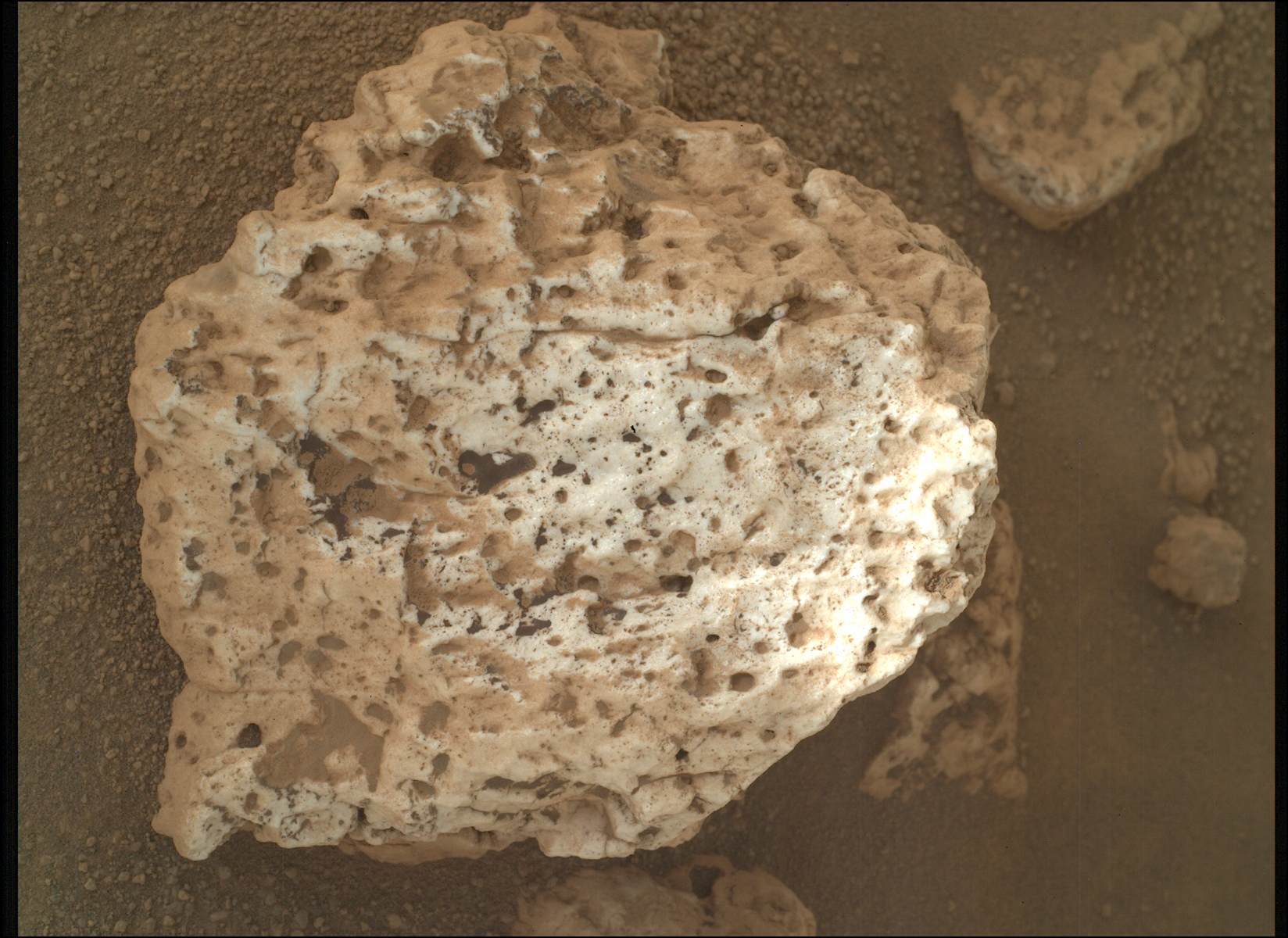
Exploration on Mars turns up the unexpected. Perseverance is equipped with a fantastic set of instruments for studying the rock record of this ancient planet. Both PIXL and SuperCam have great capabilities for detecting all kinds of elements. SHERLOC, SuperCam, and PIXL can detect minerals using various techniques including x-ray fluorescence, Raman, and infrared spectroscopies. As a side benefit of the way SuperCam performs its Raman spectroscopy, it can also study time-resolved luminescence. Normally luminescence occurs over a broad wavelength range (most of Earth’s commercial lighting uses luminescence in some way or another). Two years ago, the SuperCam team was startled to find strong, narrow luminescence peaks at two wavelengths of 692.7 and 694.1 nanometers when they shot a light-colored rock with the laser. This luminescence comes from delayed atomic transitions in chromium atoms present in a corundum mineral structure. SuperCam can time the delay of the atomic transitions via the resulting photons, and so we could verify that this emission came from chromium in corundum. The results were published in Geophysical Research Letters by a team led by Ann Ollila earlier this year, so you can read all about it. The gemstone version of chromium-containing corundum is ruby. Prior to installing SuperCam on Perseverance, we placed a ruby in the laser beam and watched the entire room pulse a brilliant red as SuperCam’s laser beam hit the gemstone; it was extremely bright.
While we haven’t found collectable rubies on Mars yet, the little corundum crystals are helping us learn more about Mars’ past. Corundum is a metamorphic and pegmatitic mineral which we would not expect to find on Mars, a planet that lacks plate tectonics. However, large meteor and asteroid impacts can create local metamorphism due to long-term heating from the impact. Because we are in a very ancient terrain near the rim of Jezero crater, we can expect some evidence of localized metamorphism. As the first mission in such terrain, we are learning new things. Earlier in the mission we tried this technique only rarely; lately we have carried out the time-resolved luminescence observations frequently on light-toned rocks to look for more evidence of impact effects. It’s great to have this unexpected tool on board as we delve further into Mars’ deep past.


九天行歌承制的 5 米直径铝合金二级共底贮箱完成双低温测试,攻克多项关键技术,验证深冷工况下结构与密封性能。

北京穿越者载人航天完成穿越者壹号亚轨道载人飞船逃逸舱静力试验,验证舱体结构强度刚度达标,支撑后续逃逸飞行试验与可重复载人飞船研制。

NASA 研发 PROMISE 极地探测漫游车,复用火星车备件、配同位素电源,计划 2028 年底登陆月球南极阴影坑,为载人基地开展资源勘察。


