
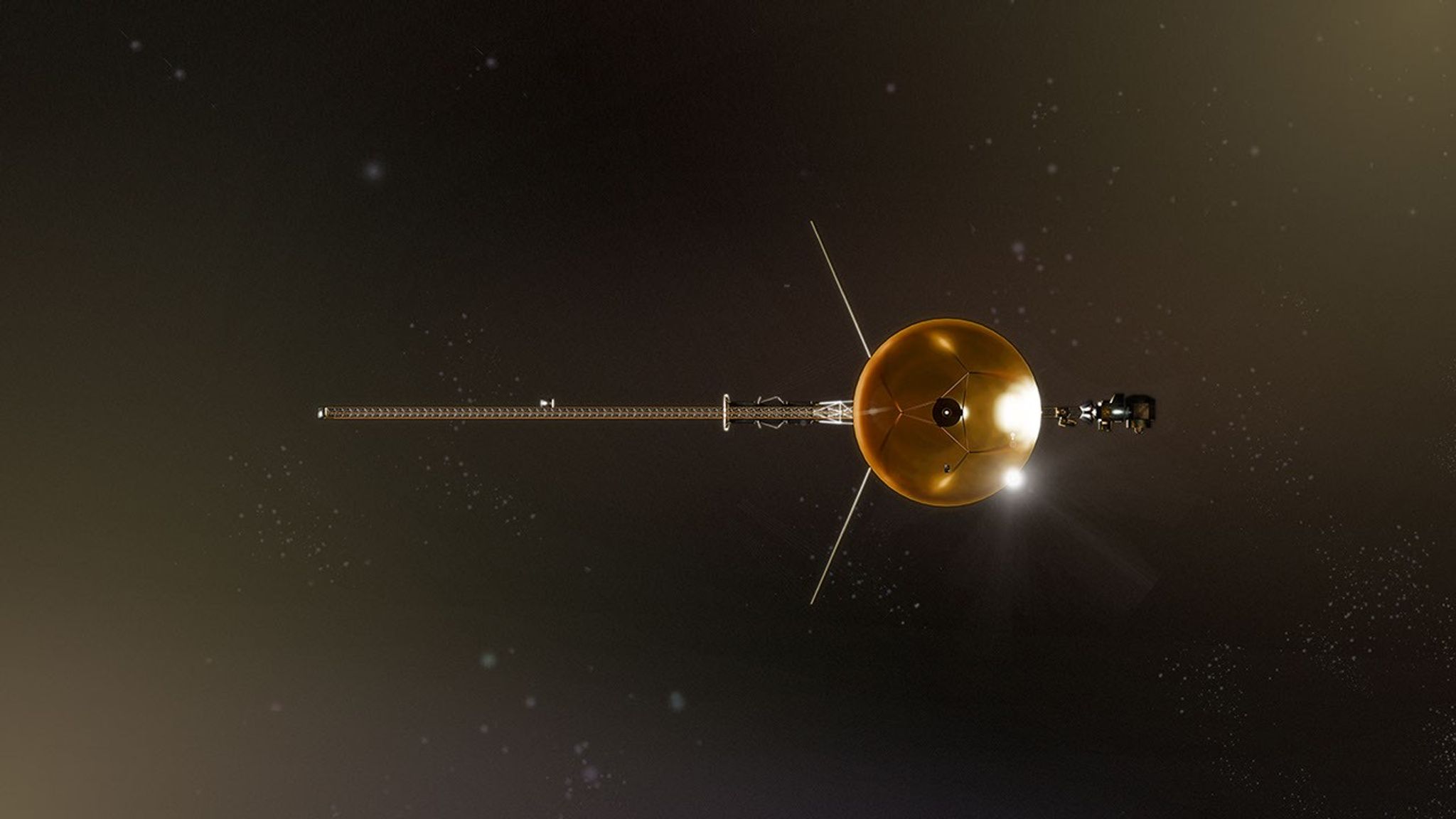
Launched nearly 50 years ago in 1977, NASA’s Voyager 1 on Wednesday, Nov. 18 will have traveled one light-day from Earth, which is more than 16 billion miles (25.9 billion kilometers). Voyager 1 is the most distant human-made object, and any light from Earth would take 24 hours to reach the spacecraft. NASA will highlight this historic milestone with two events.
On Tuesday, Nov. 17, NASA invites the world to participate in “Shine Bright for Voyager’s Light-Day” by creating a symbolic wave of golden light encircling the planet after sunset. NASA has created a website that enables smart phones and tablets to flash “VGR”, Voyager’s call sign, in morse code.
For more information about how to participate in “Shine Bright for Voyager Light-Day,” visit:
Everyone is encouraged to capture photos or videos of their light-day signal and share it on social platforms, tagging @NASA.
On Thursday, Nov. 19 at 12 p.m. EST (9 a.m. PST), NASA’s Jet Propulsion Laboratory (JPL) in Southern California will host a moderated discussion with mission members and NASA leadership about the status of Voyager 1 and 2, the unique science the twin probes continue to gather in interstellar space, and the challenges of keeping the spacecraft operating for so long over such vast distances. A Q&A with media and other audience members will follow. In addition, there also will be a preview of the upcoming NASA+ Voyager documentary, planned for release in 2027 for the mission’s 50th anniversary.
The event will take place in NASA JPL’s von Kármán Auditorium, where JPL hosted Voyager briefings during the spacecraft’s grand tour of the outer planets.
The participants will be:
Learn where to watch online at:
U.S. media interested in attending the event in person must RSVP by Monday, Nov. 16 to Josh Smooha at: josh.smooha@jpl.nasa.gov. To be considered for onsite credentials, foreign national media must RSVP no later than Thursday, Nov. 12. Media interested in participating virtually must RSVP no later than two hours before the event. NASA’s media accreditation policy is available online.
For almost half a century, the agency’s Voyager mission has blazed a trail through space. Voyager 1 and Voyager 2 were designed to explore the outer planets by taking advantage of a planetary alignment that occurs once every 176 years. Voyager 1 entered interstellar space in 2012. Following a different trajectory, Voyager 2 entered in 2018. Both spacecraft continue to provide unique scientific observations of the environment beyond the heliosphere, the protective bubble created by the Sun.
Managed by Caltech in Pasadena, California, NASA JPL built and operates the Voyager spacecraft. NASA’s Deep Space Network, also managed by NASA JPL, enables communication with the distant probes. The Voyager mission is funded by NASA’s Heliophysics Division at NASA Headquarters in Washington.
For more information about NASA’s Voyager mission, visit:
https://science.nasa.gov/mission/voyager/
-end-
Abbey Interrante / Karen Fox
Headquarters, Washington
202-358-1600
abbey.a.interrante@nasa.gov / karen.c.fox@nasa.gov
Josh Smooha
Jet Propulsion Laboratory, Pasadena, Calif.
626-298-4414
josh.smooha@jpl.nasa.gov

11 月 17 日格思信息在上海联交所启动公开增资,募资不低于 6 亿元用于扩产、研发与补流,增资后保持国有控股,公司近年营收、净利润增长显著。

航天科工空间工程总体部在武汉发布 “星汇” 卫星数据综合服务平台,可统筹多星座协同观测,依托 AI 实现卫星影像智能解译,已支撑 60 余颗在轨卫星数据处理。

11 月 17 日铱星 NTN Direct 正式激活,是全球首个商用的 3GPP 标准全域 NB-IoT 卫星直连服务,依托存量 L 波段星座,转向开放标准生态,该业务推进恰逢 Rocket Lab 收购铱星进程中。


